Compliance Receipts™
The Brief
Company: Cleo
Background: Working for Cleo, a financially regulated company based in the US, with every piece of copy I wrote I faced the same challenge: how can I make this work for the company - meeting metrics and proving a strong product-user fit, work for the user - meeting their needs and providing products that are useful, and easy-to-understand; and ensuring that it was within all necessary legal guardrails.
Problem: With a fast-paced team shipping copy iterations and new features every sprint, we found ourselves navigating a constant bottleneck: legal sign off. Every time I’d reach out to Compliance for approval, I would have to speak to a different member of the team and repeat conversations I’d had several times before - this time with just slightly varying copy.
And from their perspective, as a small team responsible for a hell of a lot more than just my squad’s output, we were asking for more than they could keep up with.
We felt the strain. They felt the strain.
Solution: Enter Compliance Receipts.
The work
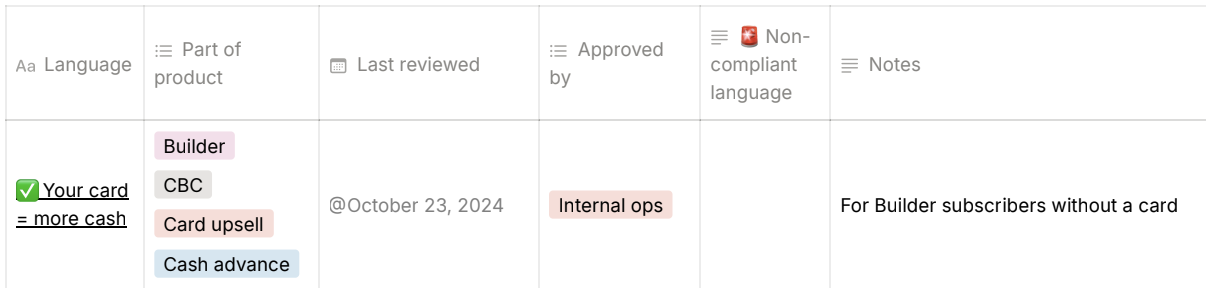
The idea was simple: a searchable, filterable database in Notion to capture the decision making that came from Compliance.
Every conversation with Compliance became an entry, complete with
The approved language
The part of the product
The date it was last reviewed
Who it was approved by (by our internal team or our external partner)
The writer
Any watch-outs for non-compliant language
Relevant notes to help future cases
A link to the JIRA ticket with the paper trail
For writers, we could use this to inform our writing early on in the project to ensure we stayed within the guardrails. And for Compliance, they could refer back to previous decision making to jog their memory when they were faced with new requests.
The outcome
Quickly showing Compliance the decisions that had been signed off previously (by themselves or other colleagues) massively reduced their workload. They didn’t need to check through the copy from scratch, but could instead see exactly why it worked with the relevant justification, streamlining the process and removing the bottleneck for us.
But the utility of the tool didn’t stop there. It also sped up things for me and other content designers. When it came to writing the copy, the database was a great resource to inform the language choice to make it more likely to be compliant from the off. It could be filtered by product area or searched using relevant terms to give writers a nod in the right direction.
This meant we could work with higher confidence that the work would be approved, reducing the number of time-consuming back and forths we often had to manage. It also meant the approval times from the Compliance team was way faster.